
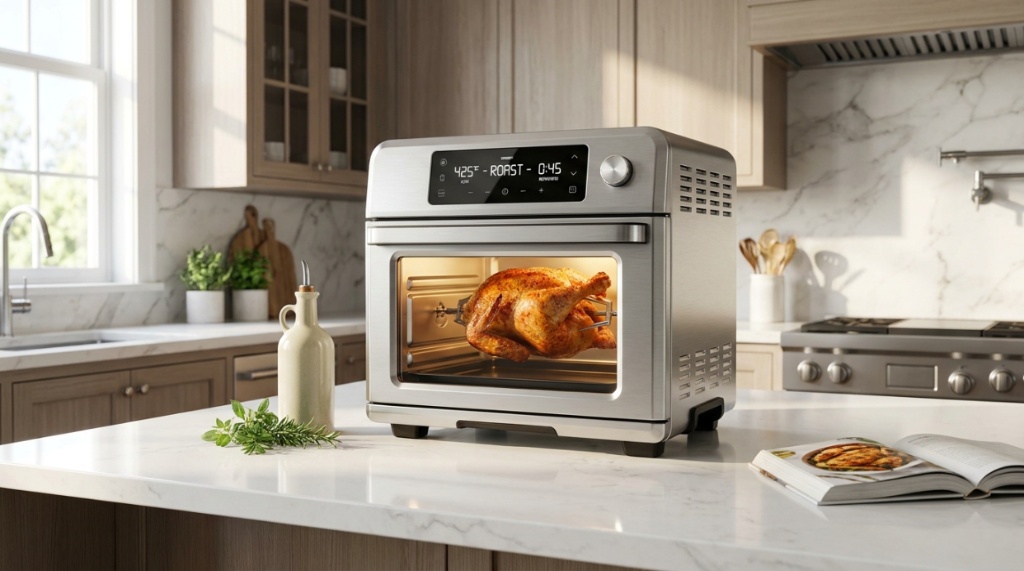
The average American household spends $1,200 annually on energy just to run their kitchen oven — and nearly 40% of that heat escapes into the room rather than cooking the food. Choosing the best smart air fryer oven for your kitchen this year means selecting an appliance that slashes energy waste, cuts cooking time by 30–50%, and delivers restaurant-quality results through precision convection technology controlled by intelligent software. A smart air fryer oven is a countertop convection cooking appliance that uses rapid hot air circulation combined with WiFi connectivity, app-based controls, built-in cooking presets, and often internal cameras or temperature probes — transforming traditional cooking from guesswork into guided precision. The problem? The market has exploded with over 200 models claiming “smart” features — ranging from genuinely intelligent appliances with recipe algorithms and automatic temperature adjustment to basic air fryers with a WiFi chip slapped on as a marketing afterthought. This air fryer oven buying guide separates meaningful smart features from gimmicks, identifies what actually matters for daily cooking performance, and helps you invest in technology that earns counter space through genuine daily utility.
What Makes an Air Fryer Oven “Smart” vs Just Connected?
A genuinely smart air fryer oven uses sensors, algorithms, or AI to automatically adjust cooking parameters based on food type and real-time conditions — while a merely “connected” oven simply lets you press start from your phone without adding cooking intelligence.
The smart feature spectrum:
| Feature Category | Genuinely Smart (Adds Value) | Marketing Smart (Minimal Value) |
|---|---|---|
| Temperature control | Auto-adjusts temperature during cooking based on probe readings or camera analysis | You set temperature from phone instead of pushing a button on the unit |
| Cooking guidance | Algorithm recommends time/temp based on food weight, thickness, and desired doneness | Static preset list identical to what’s printed in the manual |
| Monitoring | Internal camera with AI that detects browning level and alerts when food reaches target | Camera that shows raw video feed requiring you to judge doneness yourself |
| Recipe integration | App sends precise multi-step cooking instructions directly to the oven (auto temp/time changes mid-cook) | App displays recipe text while you manually adjust the oven at each step |
| Learning ability | Remembers your preferences and adjusts future cooking accordingly (lighter toast, crispier fries) | Saves your last-used settings without adapting to feedback |
| Voice control | Full cooking commands via Alexa/Google (“cook chicken breast medium-rare”) | Basic start/stop only via voice |
The distinction matters financially. Genuinely smart ovens cost $250–$700 and deliver daily time savings plus better cooking outcomes. Connected-only ovens cost $150–$400 and deliver marginal convenience over simply pressing buttons on the appliance directly. Know what you’re paying for before investing.
What Size Smart Air Fryer Oven Do You Need?
Choose your air fryer oven size based on household feeding capacity — a 10–15 quart model serves 1–2 people efficiently, 20–26 quarts handles families of 3–4, and 30+ quart (full-size countertop oven) serves families of 5+ or anyone who wants to replace their conventional oven entirely.
Size selection guide:
- Compact (10–15 quarts / 10–14 liters): Fits a 3-lb chicken, 4 servings of fries, or a 9″ pizza. Ideal for singles, couples, and small countertops. Uses minimal energy. Limitation: can’t cook a full sheet pan of food or a whole chicken above 4 lbs.
- Medium (20–26 quarts / 19–25 liters): Fits a 5-lb chicken, 6 servings of fries, a 12″ pizza, or a standard 9×13 baking dish. The sweet spot for most families. Handles 80% of cooking tasks without dominating counter space.
- Large/Full-size (30+ quarts / 28+ liters): Fits a full turkey breast, two racks of ribs, multiple sheet pans simultaneously, or a 13″ pizza. Can genuinely replace a conventional oven for daily cooking. Requires significant counter space (typically 20″+ wide).
Counter space reality check: measure your available space before browsing models. Smart air fryer ovens need 4–6 inches of clearance on all sides for heat ventilation. A 30-quart oven typically requires a 24″ × 18″ footprint with clearance — consuming as much space as a microwave. Compact models fit in 16″ × 14″ footprint spaces where most kitchens have natural counter availability.
The trend for 2024–2025: medium-size ovens (20–26 quart) with advanced smart features are dominating sales, according to NPD Group kitchen appliance data. Buyers are prioritizing cooking intelligence over raw capacity — preferring a brilliantly smart medium oven over a basic large one.
Which Smart Features Actually Save You Time Daily?
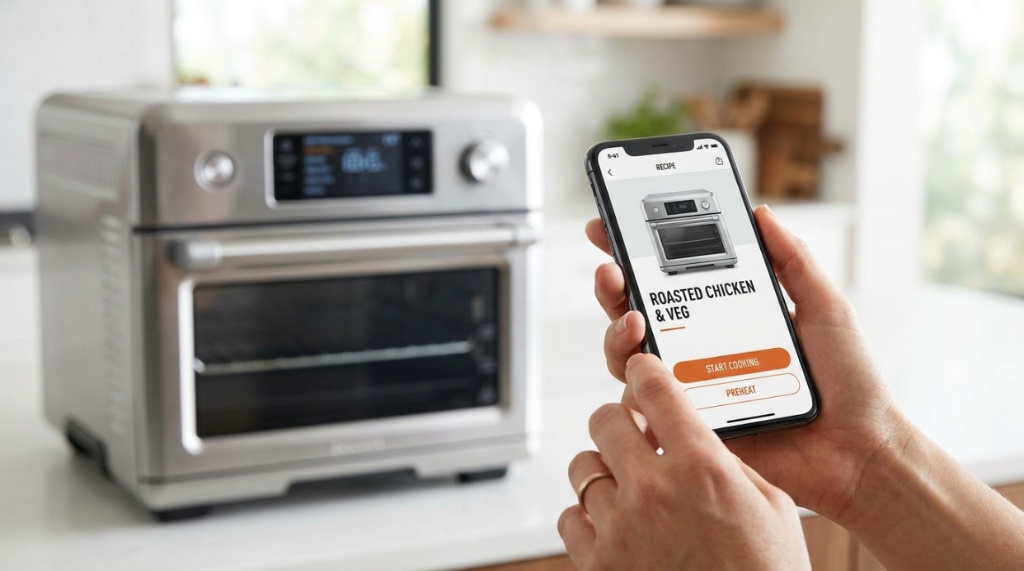
The smart features that genuinely save daily time are: auto-preheat scheduling, internal temperature probes that stop cooking at target doneness, one-touch multi-step recipe execution, and remote monitoring that eliminates kitchen hovering.
Feature-by-feature daily time savings:
- Auto-preheat scheduling (saves 5–10 min/meal): Schedule preheat from your phone while still at work or finishing errands. Oven is ready the moment you start food prep. Eliminates the dead waiting time between deciding to cook and actually beginning.
- Internal temperature probe (saves 5–15 min/meal): Meat reaches exact target temperature and the oven stops automatically — no checking, no cutting to test, no overcooking from guessing. Particularly valuable for proteins where 5 degrees difference separates perfect from dry.
- One-touch multi-step cooking (saves 3–8 min/meal): Complex recipes (start at high heat to sear, reduce to finish) execute automatically without manual intervention between stages. You load food once and walk away until it’s done.
- Remote monitoring/camera (saves 10–20 min/meal): Check food progress from another room via app. Eliminates repeated kitchen trips to peek inside. Internal camera shows browning progress without opening the door (which drops temperature and extends cooking).
- Guided cooking programs (saves 5–10 min/meal): Enter food type and weight — the oven calculates time and temperature. Removes the recipe-searching and mental math that precedes every cooking session.
Cumulative impact: a smart air fryer oven saving 15–30 minutes per meal across 2 meals daily recovers 3.5–7 hours weekly — meaningful time reclaimed for a family cooking regularly at home. The technology investment pays for itself in time value within the first month of daily use.
What Cooking Performance Specs Matter Most?
The cooking specs that determine daily performance are: wattage (1700–1800W minimum for proper air frying), temperature range (at least 200°F–450°F), convection fan speed/power, and heating element configuration (dual elements top and bottom outperform single elements significantly).
Spec-by-spec analysis:
- Wattage (1700–1800W ideal): Higher wattage = faster heat-up and better air frying crispiness. Under 1500W struggles to maintain air-frying temperatures when food is loaded — creating steaming rather than crisping. 1700W+ maintains consistent high heat even with a full basket.
- Temperature range: 200°F minimum for dehydrating and slow cooking. 450°F+ maximum for searing, pizza, and high-heat roasting. Many smart ovens offer 150°F–500°F range — exceeding conventional ovens. Wider range = more versatile cooking applications.
- Dual heating elements: Top and bottom elements heat food from both directions simultaneously — eliminating the need to flip food mid-cook. Single-element models (heat from above only) require flipping for even browning, adding a manual step that contradicts the “set and forget” smart promise.
- Convection fan power: The fan speed determines air frying effectiveness. Powerful fans (5000+ RPM) create the rapid air circulation that produces crispy exteriors. Weak fans (under 3000 RPM) circulate air too slowly — creating convection oven results rather than true air fryer crispiness.
- Even heat distribution: Multiple heating elements or strategically placed elements prevent hot spots. Uneven heat means rotating food mid-cook. Check user reviews specifically for “even cooking” or “hot spots” feedback before purchasing.
How Much Should You Spend on a Smart Air Fryer Oven?
For a genuinely smart air fryer oven with meaningful intelligence features and quality construction, budget $200–$400 for excellent mid-range options or $400–$700 for premium models with advanced AI, cameras, and multi-function capability.
Price tier breakdown:
- Under $100: Basic air fryer ovens with minimal or no smart features. Physical controls only, limited presets, adequate for simple air frying but no intelligence or connectivity. Brands: Dash, Chefman basic models.
- $100–$200: Entry smart features — app connectivity, basic presets, timer notifications. Adequate cooking performance but limited true intelligence. Good starting point for testing whether smart cooking fits your lifestyle. Brands: Cosori, Ninja (basic smart models).
- $200–$400 (sweet spot): Genuine smart intelligence — algorithm-driven cooking, temperature probes, multi-step recipe automation, quality construction. Best value for daily-use smart cooking. Brands: Breville Joule Oven Air, Cosori Smart Air Fryer Oven, Ninja Foodi Smart XL.
- $400–$700: Premium smart ovens — AI-powered cooking, internal cameras, steam injection, professional-grade elements, multi-function (air fry + bake + broil + dehydrate + proof + steam). For serious home cooks who want maximum capability. Brands: Brava, June Oven, Anova Precision Oven.
Cost-per-use perspective: a $350 smart air fryer oven used daily for 3 years costs $0.32/day. Compared to the energy savings alone (30–50% less energy than conventional ovens, saving $150–$300 annually), the appliance potentially pays for itself within 18–24 months through reduced utility bills — before accounting for reduced takeout spending from easier home cooking.
Which Brands Lead Smart Air Fryer Oven Technology?
The technology leaders in smart air fryer ovens are Breville (precision engineering), June (AI and camera intelligence), Brava (pure light heating innovation), Cosori (value-to-feature ratio), and Ninja (versatility and accessibility).
Brand strengths:
- Breville (Joule Oven Air): $350–$500. Precision temperature control, Element IQ technology that adjusts individual heating elements in real-time, seamless app integration with ChefSteps Joule recipes. Best for: precision cooks who want reliable consistent results.
- June (June Oven): $500–$700. Internal HD camera with food recognition AI, automatic cooking program selection based on what the camera sees, continuous monitoring with done-ness alerts. Best for: tech-forward households wanting maximum automation.
- Brava: $400–$600. Pure infrared light heating (no traditional elements) that reaches full temperature in seconds. Zone cooking (different temperatures in different areas simultaneously). Best for: speed-focused cooks and tech enthusiasts.
- Cosori: $150–$300. Excellent VeSync app integration, solid presets, reliable air frying at accessible pricing. Best for: value-conscious buyers wanting genuine smart features without premium pricing.
- Ninja (Foodi Smart XL): $200–$350. Maximum versatility (air fry, bake, broil, roast, dehydrate, reheat, toast, bagel). Probe thermometer integration. Best for: families wanting one appliance to replace multiple units.
While a compact smart countertop model is perfect for daily home cooking, large families or home-based catering businesses might find themselves restricted by its capacity. If your cooking demands go beyond everyday meals, you might need to scale up your setup. What should you look for before buying a commercial oven? Understanding the distinct differences in temperature recovery times, ventilation needs, and raw power will help you decide if upgrading to a heavy-duty unit is the right move for your space.
What Should You Check Before Buying?
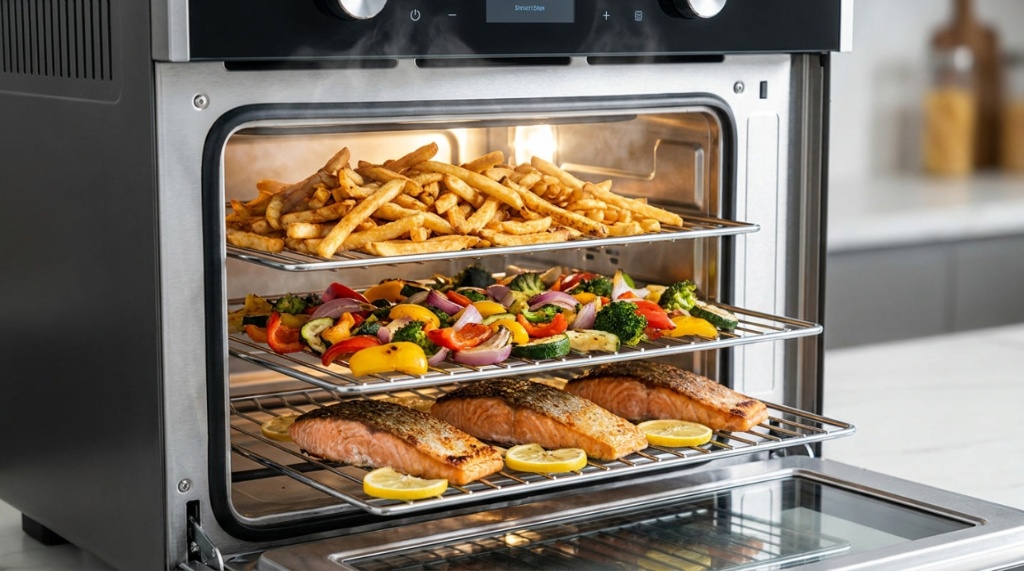
Before purchasing, verify: app compatibility with your phone OS, WiFi requirements (2.4 GHz vs 5 GHz), actual interior cooking dimensions (not just quart capacity claims), warranty length, and long-term app support commitment from the manufacturer.
Pre-purchase verification checklist:
- App store reviews: Download and check the companion app’s reviews before buying the oven. A brilliant oven paired with a buggy, abandoned app delivers frustration rather than smart cooking. Look for recent updates (active development) and ratings above 4.0 stars.
- WiFi band compatibility: Many smart ovens connect only to 2.4GHz WiFi networks — not the 5GHz band that newer routers default to. Verify your home network offers 2.4GHz before purchasing to avoid connectivity frustration during setup.
- Interior dimensions vs. marketing capacity: “26 quart” doesn’t tell you whether your 12″ pizza or 9×13 casserole dish fits inside. Check actual interior width × depth × height measurements and compare against your most-used cookware and baking dishes.
- Warranty and support: Smart appliances can become “dumb” if the manufacturer discontinues app support. Choose brands with strong track records and stated commitment to ongoing software updates. Minimum 1-year warranty; premium brands offer 2–5 years.
- Noise level: Convection fans generate noise. Higher-power fans (better air frying) = more noise. If your kitchen opens to living areas, check user reviews mentioning fan noise during operation. Some models are notably louder than others.
- Cleaning access: Can you remove the crumb tray easily? Is the interior non-stick coated for wipe-clean maintenance? Are the racks dishwasher-safe? Daily-use appliances that are difficult to clean become daily-frustration appliances quickly.
Conclusion
Choosing the best smart air fryer oven for your kitchen requires matching genuine intelligence features to your cooking habits, selecting appropriate capacity for your household, and investing in a brand committed to ongoing software support that keeps your appliance smart long-term. The technology has matured significantly — today’s best models genuinely reduce cooking time by 30–50%, cut energy usage meaningfully, and produce better results than conventional ovens through precision temperature management impossible with manual cooking.
Focus on features that save you time daily — temperature probes, multi-step automation, and remote monitoring deliver the most practical value. Skip features that sound impressive but add minimal real utility (voice commands that are slower than pushing a button, cameras without AI analysis). Invest $200–$400 for excellent smart performance, verify app quality before purchasing, and let intelligent cooking technology transform your daily relationship with your kitchen from obligation to efficiency.
Frequently Asked Questions
Is a smart air fryer oven worth the extra cost over a basic air fryer?
If you cook daily, yes — smart features save 15–30 minutes per meal through automation, eliminate guesswork with temperature probes, and improve results through algorithm-optimized cooking. If you use an air fryer only 2–3 times weekly for simple tasks (reheating, frozen foods), a basic model delivers adequate results without the smart premium. Daily cooks see the fastest ROI from smart features.
Can a smart air fryer oven replace my regular oven?
For daily cooking (1–4 person households), yes — a 26+ quart smart air fryer oven handles 85–90% of what a conventional oven does while using 50% less energy and cooking 30% faster. Limitations: you can’t fit a full Thanksgiving turkey, multiple large casserole dishes simultaneously, or very tall baked goods. For large-family cooking or holiday meals, you’ll still need the conventional oven occasionally.
How long do smart air fryer ovens last?
Quality smart air fryer ovens (Breville, Ninja, Cosori at $200+) typically last 3–5 years of daily use. Heating elements and fans are the components most likely to fail first. The smart features (app, WiFi) remain functional as long as the manufacturer maintains the companion app — a risk unique to smart appliances that traditional ovens don’t face. Choose brands with established app support histories.
Do smart air fryer ovens use a lot of electricity?
Smart air fryer ovens use 1200–1800 watts—comparable to a hair dryer or microwave. However, their shorter cook times mean less total energy per meal than conventional ovens (which use 2000–5000 watts for longer periods). Average annual operating cost: $50–$80 for daily use. Compared to conventional oven operation ($150–$250 annually), smart air fryer ovens save $70–$170 per year in energy costs.
What’s the difference between an air fryer oven and a regular air fryer?
An air fryer oven uses a horizontal convection design (like a miniature conventional oven) with racks, while a regular air fryer uses a vertical basket design with a drawer. Oven-style models offer more capacity, even cooking on multiple racks, and baking/broiling versatility. Basket-style air fryers are more compact, heat faster for small batches, and are easier to clean. Smart features are more common in oven-style models due to their higher price positioning.
Are cheap smart air fryer ovens any good?
Under $150, “smart” usually means basic WiFi connectivity with limited value. The cooking performance of budget models varies widely—some deliver adequate air frying while others underheat and undercrisp. If the budget is constrained, prioritize cooking performance (wattage, dual elements, fan power) over smart features. A well-performing $100 basic oven outdelivers a poorly performing $150 “smart” oven that merely adds an app to subpar cooking capability.