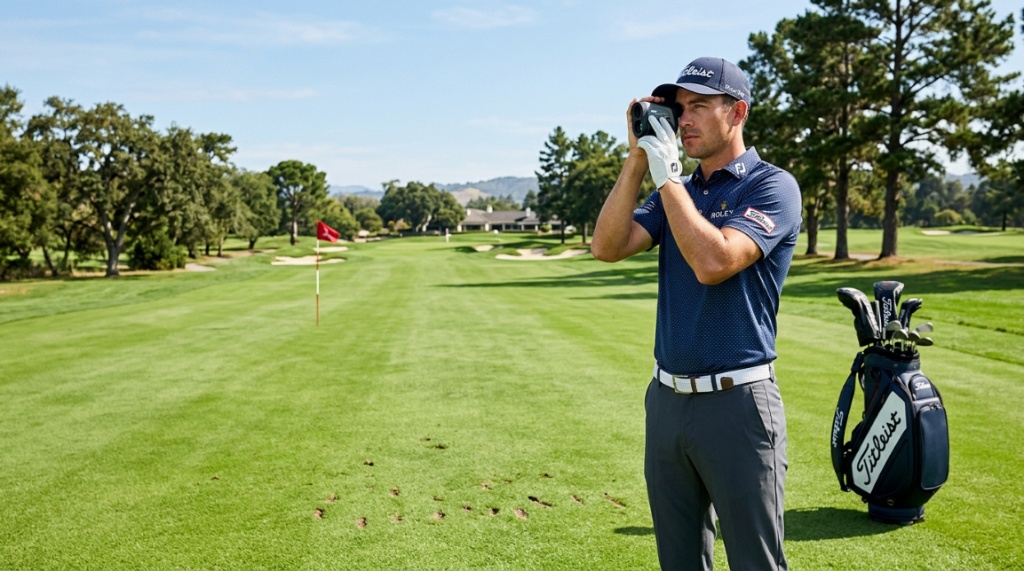
You know the feeling. You’re standing over your ball, squinting at the flag, pacing off yardages, pulling a club, second-guessing yourself, and then putting it back. Meanwhile, the group behind you is tapping their toes. Slow club selection isn’t just annoying—it kills your rhythm and adds unnecessary strokes to your round. The problem isn’t your ability to hit the ball; it’s your inability to make a confident, fast decision about which club to use.
The modern solution isn’t just about knowing the distance—it’s about golf rangefinder speed club selection. A quality rangefinder eliminates guesswork, cuts decision time in half, and gives you the data you need to commit to your shot instantly. This guide will show you exactly how to shave seconds off every pre-shot routine while improving accuracy, all by mastering the technology already in your hands.
We’ll walk through the mechanics of fast target acquisition, how to interpret data quickly, and how to build a streamlined pre-shot routine that feels automatic. By the end, you’ll not only play faster but also shoot lower scores because confidence comes from clarity.
What Is the Fastest Way to Get a Yardage Reading?
The fastest way to get a yardage reading is to use a rangefinder with fast focus technology and scan mode. Once you master the “flag lock” feature, you can get an accurate reading in under three seconds. The key is eliminating unnecessary movements and knowing exactly where to aim the reticle before you even raise the device.
Speed comes from preparation and technique, not just from the device itself. Even a premium rangefinder will be slow if you don’t know how to use it efficiently. Let’s break down the exact process.
Master the Flag Lock Feature for Instant Targeting
Modern rangefinders with “Flag Lock” or “PinSeeker” technology vibrate or display a visual ring when they lock onto the flagstick. To use this quickly, first find the flag with your naked eye from behind your ball. Then, in one smooth motion, raise the rangefinder to your eye, keep the reticle on the flag, and press the button. This eliminates the common mistake of searching for the flag through the lens, which wastes precious seconds.
Use Scan Mode for Multi-Target Situations
If you’re playing a blind shot or need to know distances to hazards, bunkers, and the green simultaneously, scan mode is your best friend. Instead of pressing the button repeatedly, hold it down and slowly sweep the landscape. The device will continuously update the distance. This gives you a “lay of the land” in a single pass, letting you make a club choice based on total picture rather than just pin distance.
Keep Your Non-Dominant Eye Open
Keeping both eyes open while looking through a rangefinder reduces the “tunnel vision” effect and helps you maintain spatial awareness. It stabilizes the target lock because your brain can reconcile the magnified image with the real-world view. This takes some practice, but golfers who master this technique report significantly faster lock-on times and less eye fatigue.
How Does Slope Compensation Affect Decision Speed?
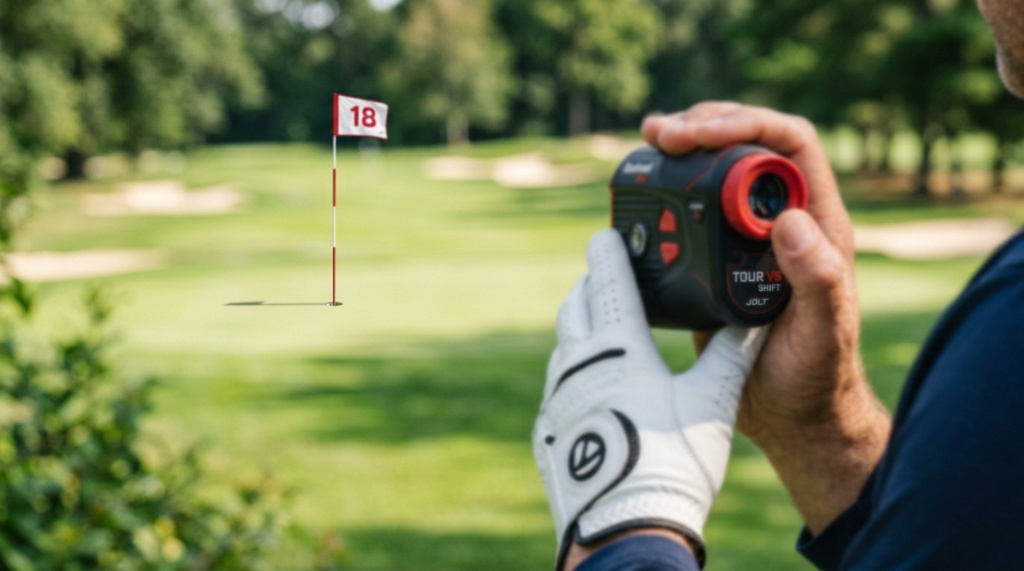
Slope compensation can speed up your club selection if you understand the number instantly, or it can slow you down if you overthink it. The rule is simple: the rangefinder calculates the adjusted distance, so you don’t have to. You simply take the number it gives you and use that yardage, no mental math required.
However, many golfers slow down because they see the “slope number” and the “actual number” and start debating which one to use. In tournament play or casual rounds where slope is allowed, you must trust the technology immediately to maintain pace.
Understanding Adjusted Distance vs. Actual Distance
The actual distance is the straight-line yardage from you to the pin. The adjusted distance (slope) factors in the elevation change—uphill or downhill. When you’re playing uphill, the adjusted distance will be higher than the actual; playing downhill, it will be lower. Trusting this computation saves you from having to visualize the elevation and calculate in your head, which is a huge time-saver.
When to Turn Slope Off for Faster Play
If you never play in competitions that prohibit slope, leaving it on is fine. However, if you switch between competition and casual play, reprogramming your mindset slows you down. A good trick is to keep slope on for practice rounds to learn your true distances, but turn it off on the course to simplify your decisions to just one number. Fewer numbers mean faster choices.
Avoid the “Paralysis by Analysis” Trap
Do not stand there staring at the distance to the front, back, and pin, trying to decide which part of the green to target. Pick a specific target (usually the pin or the center of the green), get that number, and hit. You are not a tour pro hitting to a tucked pin on Sunday; you are playing recreational golf. Speed up the process by committing to the very first reading you take.
Why Is Confidence the Secret to Faster Club Selection?
Confidence is the secret sauce to fast club selection because a confident golfer makes a decision and executes. Rangefinders build confidence by providing objective, numerical proof of distance. When you know the distance within one yard, you stop doubting your club choice, which dramatically reduces the time spent waffling between the 7-iron and the 6-iron.
The physical act of pulling a club should be a reflex, not a debate. Let’s explore how to build that muscle memory and mental certainty.
The Psychology of “Good Enough”
Perfectionism is the enemy of speed. If you wait for the wind to die down, the sun to stop shining, and the flag to stop moving, you’ll never hit. A rangefinder gives you the yardage, but you must accept that the wind, temperature, and lie are variables you must estimate quickly. Accept a margin of error of 3-5 yards and commit to your club. This “good enough” mindset is often the difference between a 3-hour round and a 4.5-hour round.
Building a Repeatable Pre-Shot Routine
Your routine should sound like this: Shot distance (from rangefinder) → Wind check (feel on face) → Lie check (look at ball) → Club selection (automatic) → Practice swing (optional) → Hit. When you follow this sequence every single time, without skipping steps, you train your brain to move quickly. The rangefinder reading is just the first domino; don’t let it be the bottleneck.
Trusting the Number Over the “Feel”
Most amateur golfers overestimate their distance. A rangefinder tells you the truth. When you feel like you “crushed” a 9-iron, but the rangefinder says it went 125 yards, you must trust the device and select that club next time. Once you consistently trust the number over your ego, you’ll stop reliving past shots and focus on the present one, which is inherently faster.
Can a Rangefinder Actually Reduce Your Handicap?
Yes, a rangefinder can reduce your handicap by ensuring you are always playing the correct club for the distance. In fact, a study on amateur golfers indicates that most players are consistently 1–2 clubs short because they misjudge distances. Hitting the right club puts you on the green more often, leading to fewer putts and lower scores.
But the handicap reduction isn’t just about physical accuracy; it’s about mental clarity. Knowing you have the right club allows you to swing freely, which often results in better contact and shot quality.
Shots Gained: The Data Behind Distance Accuracy
“Strokes Gained” analytics show that proximity to the hole from approach shots is the single most significant factor in scoring. Being 10 yards closer to the hole on an approach shot significantly increases your birdie or par save percentage. A rangefinder guarantees you are within that 10-yard window more often, directly improving your statistical efficiency.
Eliminating the “Tweener” Club Problem
We all have that gap—the yardage between clubs where you can’t decide. Is it a hard 8-iron or an easy 7-iron? A rangefinder with 1-yard increments helps you categorize these “tweener” distances. Once you learn your exact carry distances, you can confidently select the harder or softer club based on a precise number, eliminating the most common hesitation on the golf course.
Simplifying Your Practice Sessions
Using a rangefinder on the range allows you to verify your club gapping. Instead of hitting 50 balls with a 7-iron aimlessly, you can laser the flag, hit, and check the landing zone. This quick feedback loop helps you learn your true distances faster, making your on-course decisions quicker and more intuitive.
Which Features Should You Prioritize for Maximum Speed?
When looking for a gadget to improve your pace, you should prioritize features that minimize input and maximize output: fast focus, vibration lock, and a clear display. Don’t get bogged down by unnecessary features like game-tracking apps or extensive weather data if you just want to play faster.
Let’s break down the hardware and software elements that genuinely make a difference in how quickly you can get a number and hit.
The Importance of Optical Quality (Lens Clarity)
If the lens is crystal clear, you can acquire the target faster. Look for rangefinders with fully multi-coated optics. A brighter image reduces the time your eye needs to adjust and find the pin, especially in low-light conditions like early morning or dusk. This is a simple way to ensure your golf rangefinder speed club selection doesn’t get bogged down by poor visibility.
Magnification Power: 6x vs. 7x
Most rangefinders are between 6x and 7x magnification. While 7x sounds better, it can be harder to hold steady, causing the flag lock to struggle. A 6x magnification is often faster for the average player because the field of view is wider and easier to stabilize. Unless you have incredibly steady hands, sticky with a 6x for speed.
Size and Weight Considerations
You are more likely to use a rangefinder quickly if it feels good in your hands. A bulky, heavy unit will be awkward to pull in and out of your bag. Look for a compact, lightweight model that fits easily in your hand or pocket. The faster you can draw it, the faster you can shoot.
How Do You Integrate a Rangefinder into Your Routine Without Delay?
You integrate a rangefinder into your routine without delay by making it an extension of your hand. It should never be a “second thought” or an item you spend time searching for in your golf bag. It must be in the same pocket, every time, ready for use.
Here is the exact sequence to incorporate it effectively:
Step-by-Step: The 10-Second Pre-Shot Sequence
- Reach for the rangefinder: As you approach your ball, before you even start walking up to it, have your hand on the device (if you don’t ride, keep it on your waist).
- Shoot the pin: Do this while your playing partners are taking their shots, or immediately when you reach your ball.
- Memorize the number: Say the number out loud to yourself: “One forty-seven.” This audio cue solidifies the decision.
- Put the rangefinder away: Immediately return it to your pocket. Do not hold it while you swing—this clutters your hands.
- Select your club: Walk to your bag, grab the club that matches “147” without hesitation.
Where to Keep Your Rangefinder on the Bag
Keep it in a dedicated magnetic clip on the side of your bag or in the hip pocket of your trousers. If it’s stuck at the bottom of a pocket under gloves, tees, and balls, you will waste time digging for it. A magnetic rangefinder case attaches to the handlebar of a push cart or the frame of a golf cart for instant access.
Practicing at Home to Improve On-Course Speed
You can practice your golf rangefinder speed club selection technique in your living room. Take the device, aim at a picture on the wall, lock on, and put it down. Repeat this 20 times a day. You’ll be amazed at how drill-like repetition ingrains the muscle memory needed to do it smoothly under pressure on the course.
What Are the Common Mistakes That Slow Down Golfers?
The most common mistake is “hunting” for the flag. Golfers often raise the rangefinder, look through it, and wave it around trying to find the pin. This is a massive time sink. The fix is to align the reticle with the flag before you press the button.
Let’s look at other pitfalls that sabotage pace of play and how to fix them.
Taking Multiple Readings for the Same Shot
Once is enough. Take the reading, write it in your memory, and move on. Taking a second or third reading rarely changes the yardage by more than a yard, so it only adds time and seeds doubt. Commit to the first number, just like you would with your first instinct on a putt.
Fiddling with Diopter/Settings
Set your diopter (the focus ring on the eyepiece) once at the beginning of the round and never touch it again. If you feel the need to adjust it constantly, you likely need reading glasses or a different eyepiece cover. Constant fiddling is a sign of a technical issue, not a process issue.
Using the Rangefinder for Every Single Shot
If you are playing a par 3 that you know is 110 yards after you played it yesterday, you likely don’t need to laser it again if your memory is accurate. But if you are unsure, laser it. The rule is: use the device for approach shots into greens, but rely on your GPS or knowledge for hazard distances. This filters out unnecessary usage and keeps play fluid.
Before heading out to the course, it is also important to maintain your gear properly so your equipment performs reliably every round—learn more about how ultrasound cleaning works to keep your gear in top shape.
Is a Rangefinder Better Than a GPS Watch for Speed?
Yes, a laser rangefinder is faster and more accurate for specific club selection because it gives you the exact pin distance, rather than a front/middle/back reading. A GPS watch shows you the distance to the front of the green, which requires mental calculation to approximate the pin, adding potential for error and slower decision-making.
However, both tools have their place. Let’s compare them for speed and usability.
Head-to-Head Comparison: Rangefinder vs. GPS
| Feature | Laser Rangefinder | GPS Watch |
|---|---|---|
| Target Specificity | Exact pin/hazard target | General front/middle/back |
| Speed of Use | Slow (must raise and aim) | Fast (look at wrist) |
| Accuracy | ± 1 yard | ± 3-5 yards |
| Slope Function | Yes (adjustable) | Yes (adjustable) |
The Best Option for Walkers
If you walk the course, a GPS watch is definitely faster because you don’t have to stop or use your hands. You glance at your wrist and go. However, that speed sacrifices the pin-specific accuracy needed for the tweener club distance. If speed is your absolute priority and you are a walker, a GPS watch is the winner.
The Best Option for Accuracy
If accuracy trumps speed, the rangefinder wins hands-down. You spend 3 extra seconds aiming but gain the certainty of the exact distance to the pin, which often prevents that 5-yard miss that results in a bunker shot instead of a birdie putt. For club selection specifically, the rangefinder provides unstoppable confidence.
Conclusion
Speeding up your club selection is about removing doubt and trusting your data. A rangefinder is the definitive tool that gives you the precise numbers needed to commit to your shot with confidence. By mastering the flag lock, trusting slope calculations, and implementing the 10-second pre-shot sequence, you can cut minutes off your round and lower your score.
Don’t let the group behind you pace the tee box while you flip-flop between irons. Invest in your game by learning how to use this technology to its full potential. Get your rangefinder in hand, practice the quick lock-on, and watch your pace of play and your handicap improve simultaneously.
Your next round is waiting. Get out there, make a decision, and hit the shot.
Frequently Asked Questions
Can I get a fast reading on a range finder if I have shaky hands?
Yes, use “Scan Mode” and rest the rangefinder against a tree, a cart, or your own chest to stabilize it. Continue to hold the button down; the device will lock onto the flag when it finds it, even if you slightly shake, because the scan feature continuously updates the distance.
Do high-end rangefinders lock onto the flag faster?
Yes, generally. Premium models feature advanced processors and DSP (digital signal processing) that can differentiate the flag from background trees faster and more reliably. They also use shorter wavelengths that reflect better off the flag prism, resulting in a quicker lock-on time.
Should I use a rangefinder during my practice rounds to speed up club selection?
Absolutely. You should always use it during practice to learn your distances. Once you know your carry distances are dialed in, you can sometimes speed up by using GPS on the course, relying on memory. But practicing with a rangefinder builds the muscle memory for fast use.
Will using slope mode slow down my club selection?
It only slows you down if you debate the number. If you are playing with slope on, adopt the adjusted number immediately as your target distance. If you find yourself confused, turn slope off and just use the straight line for faster decision-making regarding the flagstick.
What is the ideal magnification for speed in a rangefinder?
6x magnification is ideal for speed for most golfers because it provides a wider field of view, making it easier to find the flag quickly. Higher magnification like 7x can be harder to stabilize and may lead to a slower acquisition time for amateur golfers.